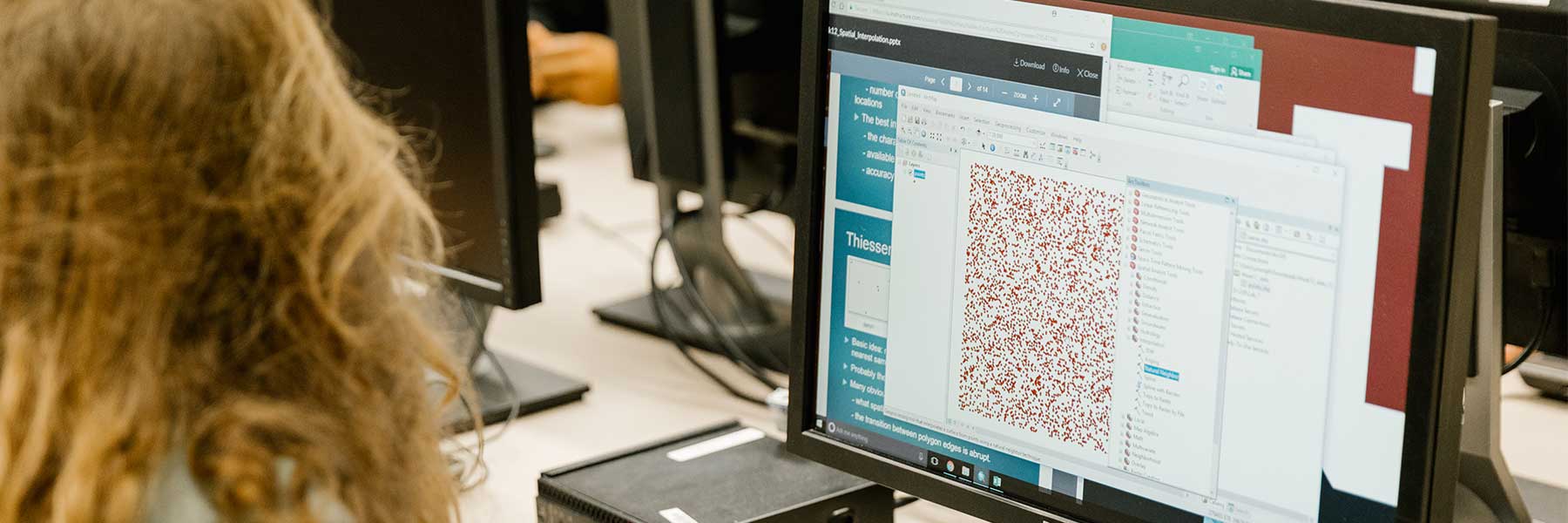
Are you a visual learner and hope to use cutting-edge geospatial technology in your career? Our Master of Geographic Information Science (MGIS) program equips you with applicable skills in demand among contemporary professionals.
Through our MGIS program, you will develop technical skills in theory and real-world applications, focusing on geo-visualization, digital mapping, geospatial data management and analysis, GIS programming and cloud computing, spatial modeling, and GeoAI applications across diverse research and industry sectors. After completing GIS and Remote Sensing courses, many of our students have careers as GIS analysts/specialists/coordinators and environmental consultants in various fields, including government, state, county, and municipal agencies; NGOs; the private sector; and academia.
Master of GIS (MGIS)
Our MGIS curriculum
30 hours of graduate-level coursework are required.
- Core Curriculum (12 credits): Introductory GIS (GEOG-G538), Environmental Remote Sensing (GEOG-G535), Advanced GIS (GEOG-G539) and GIS programming (GEOG-G585)
- Electives (12 credits): Advanced and topic-specific geospatial methods
- Elective in Application Areas (3 credits): A 3-credit course in a GIS application area, but not necessarily a course where GIS skills are taught. Examples include political science, social science, public health, geomorphology, and beyond. Requires prior approval. A final paper or project that relates to GIS
- Internship or Practicum (3 credits.)
Interested in applying to MGIS?
Please get in touch with Darren Ficklin (dficklin@iu.edu) and Yuri Kim (yurikim@iu.edu) with any questions about our professional degree program.
 The College of Arts